The best dating apps in the Philippines come with a head start you won’t get anywhere else in the region: you already share a language. English is everywhere here, so there’s no translation app sitting between you and a good conversation. That changes what the app is actually for. It isn’t there to bridge a language gap or to ration your matches. Its real job is helping you filter for who’s genuine in a country that manages to be warm, deeply online, and quietly family-minded all at once. Get that filter right and dating here is some of the easiest in Asia.

AsiaFlare: skip the swiping, message real people directly
Start where the guessing is smallest. AsiaFlare lets you look before you commit, instead of swiping blind and waiting to see who swiped back.
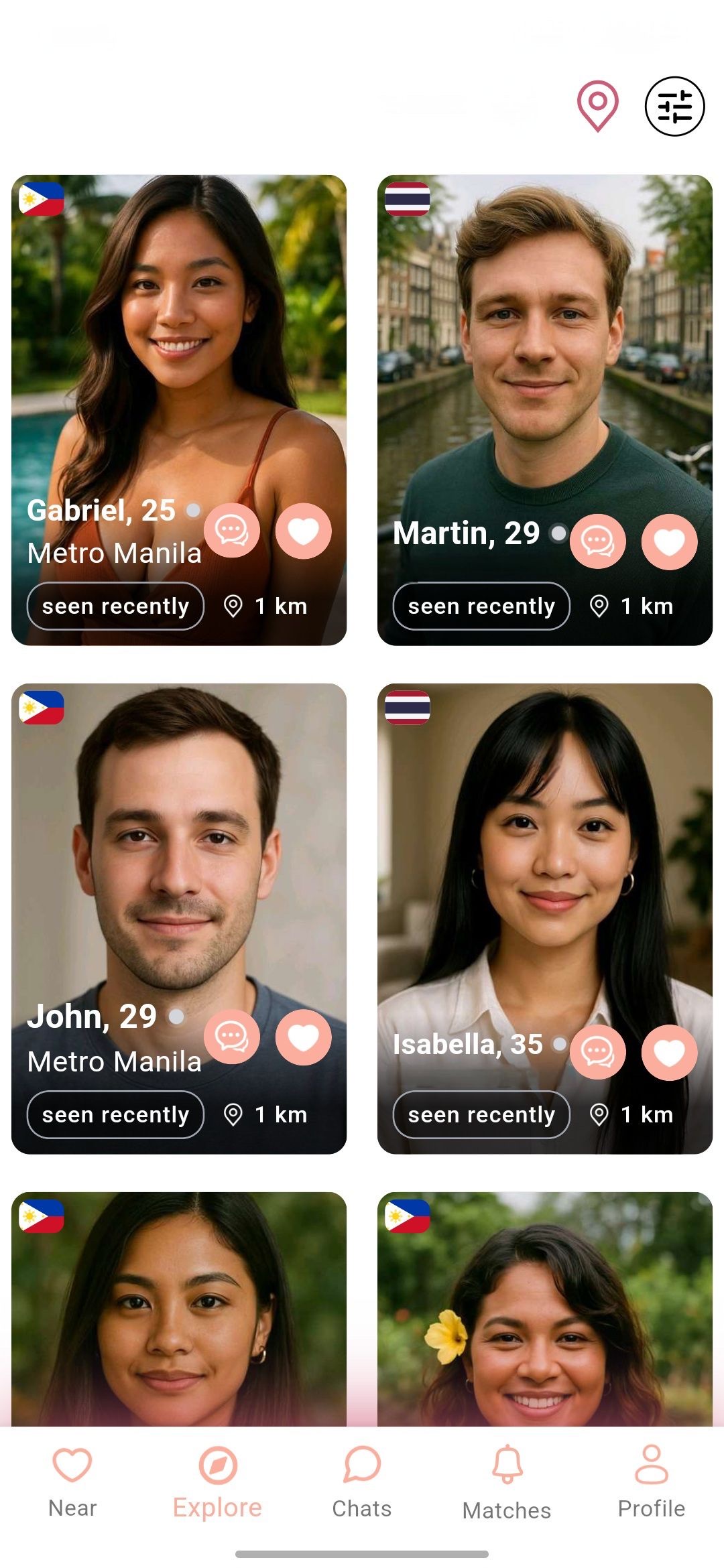
Explore shows a grid of real, active profiles sorted by who’s been online recently, and you narrow it to exactly who fits: age, lifestyle like drinking or smoking, and whether you’re after locals or fellow foreigners. Near does the same by who’s closest right now, which earns its keep when you’re actually in Manila or Cebu and want to meet this week rather than next month. On either one you message first, no match required, and chat stays free with no credit paywall waiting to interrupt a good conversation. It’s actively moderated, so a report or block takes two taps, and Incognito lets you browse without broadcasting that you’re online.
Two things matter for a country people often visit before they move. Globalist lets you set your location to the Philippines before you fly, so you land with conversations already going instead of starting from zero on day one. And because one app covers six countries, if your trip carries on to Vietnam or Bali your matches travel with you. For the wider before-you-go picture, dating across Asia walks through setting all of this up ahead of a trip.
Why the Philippine dating app scene plays differently
Filipinos are among the most online people anywhere, and it shows in dating. Meeting through an app carries no stigma, group chats and social media do a lot of the early legwork, and a match will often move to a longer chat faster than you’d expect. The upside is obvious. The catch is volume: when messaging is this easy and this constant, plenty of it never goes anywhere, and telling the real conversations from the pleasant-but-idle ones is the actual skill.
The other apps split into two rough camps. The homegrown and niche ones, like FilipinoCupid and the marriage-leaning Christian Filipina, run heavily foreigner-meets-local and draw an older, more settled-down crowd. The global names, Tinder, Bumble, and Hinge, pull a younger, more urban pool in Metro Manila and Cebu, and work the way they do at home: match first, then talk. Each has a lane. None of them let you simply browse who’s active and write to the person that stands out, which is the part that saves you the most time here.
Filipino warmth is real, but it isn’t always romantic interest
Here’s the honest complication. Filipinos are genuinely, unusually friendly, and that warmth is real hospitality, not a signal you should read as flirting. A long, giggly chat can mean she likes you, or it can just mean she’s nice to everyone, and newcomers misread that line constantly. Look for the small tells instead: does she ask questions back, suggest a time to actually meet, keep the thread going when you’re not the one starting it. Effort that flows both ways is the signal, not friendliness on its own.
There’s also a money line worth naming plainly, because a lot of guides tiptoe around it. If a conversation turns to cash early, a request for phone load, a sudden emergency, a sick relative, help with a bill, treat it as your cue to slow right down. Most people you’ll meet are just dating and this will never come up. But the pattern is common enough with romance scams that it’s worth knowing before you’re charmed, not after. Genuine interest doesn’t come with an invoice.

From MU to marriage: how serious is this, really?
One local idea saves a lot of confusion: MU, short for “mutual understanding.” It’s the in-between stage where two people act like a couple, minus the label, and it can run for weeks before anyone makes it official. It isn’t quite casual and it isn’t quite exclusive, and knowing it exists stops you from misreading where you stand. For the deeper roots of how courting works here, our guide to courtship in the Philippines covers the traditions the apps sit on top of.
Casual dating is real too, though it’s kept more discreet than in the West, since a Catholic, family-centered culture still watches. And when things get serious, family arrives early rather than late: meeting the parents is a genuine milestone, not a formality, and a warm welcome from them counts for a lot.


